Discuss the theories and models of development rooted in systemic, contextual, and social ecology that most closely aligns with your cultural development.
For the sake of this discussion, I would like to first define several terms, I will start with cultural development as it relates to lifespan development. According to Albert and Trommsdorff (2014), human development is affected by culture (customs of a group), and human development also affects culture; meaning that cultures and human development are continually interacting with one another. Secondly, I will define what is meant by contextual factors or the contextual perspective on human development. The contextual perspective on lifespan development explores the relationships between individuals and their social, cognitive, and physical worlds (Hazen & Mazur, 2024). Lastly, I want to define systemic as well. Systemic refers to something that affects an entire system.
Next, I will give a brief synopsis of my childhood environment. I grew up on a dairy farm in rural northeastern Wisconsin on a dirt road in the 1970’s and 1980’s; my nearest neighbor was over half a mile away. Both of my parents were alcoholics, and both sides of my family have deep rooted alcoholism, abuse, and mental health issues present throughout many generations; these issues are systemic in my family system. Due to alcoholism, drug abuse, and inappropriate adult behaviors my brother and I were often neglected and abused. In addition, due to the isolated geographic location we lived in there was little interaction outside of school with other families or children. The community I lived in was made up of primarily Scandinavian and German families who made their living running dairy farms. Differences, or being different was not acceptable.
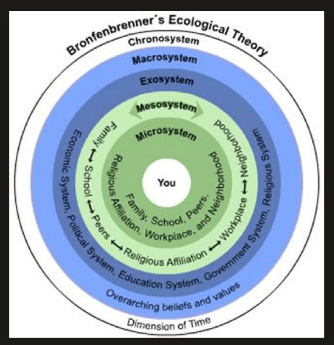
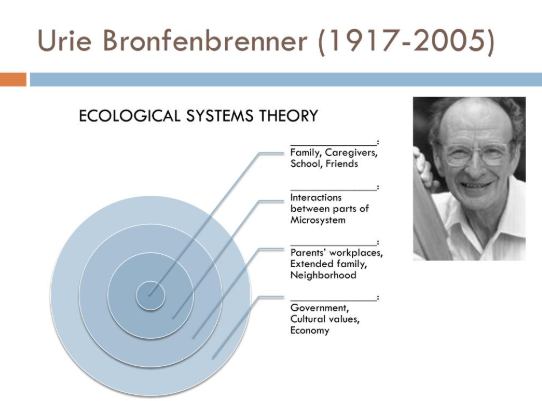
The Theory that most closely aligns with my cultural development is Bronfenbrenner’s Bioecological Model. This model is focused on many nested layers of the child’s environment which contribute to their development. The nested layers move from the child’s inner circle to more outward circles; they are as follows: (1) the child; (2) microsystem, family and friends; (3) mesosystem, teachers and peers; (4) exosystem, neighborhood and community; (5) macrosystem, culture; (6) chronosystem; time, both historical and within lifetime (Coker et al., 2022). Bronfenbrenner suggests that children are impacted at all these levels and that understanding the dynamics and context of all these levels was the key to unlocking a child’s potential (Hazen & Mazur, 2024). This model is oftentimes used in the social work and mental health fields as it explores the child’s individual circumstances more thoroughly and can explain maladaptive behaviors and characteristics that may be negatively impacting the child.
I resonate with this model due to the unique circumstances of my childhood. My brother and I were labeled as bad or odd at times and were approached by our guidance counselor on individual levels. However, these brief meetings were taken no further than to ask if we were doing okay. Of course, over time, my brother and I developed many more issues: alcoholism, drug addiction, depression, anxiety, legal problems, problems socializing, problems with authority, trouble maintaining relationships, and a plethora of other problematic mental health issues and behaviors. When I look at this model, I feel a sense of relief for those children who may be assisted with it. I can understand how knowing and understanding the unique dynamics of a child’s environment could be of assistance in helping them to unlock their potential, or in the least help them to handle their confusing emotions and behaviors.
On an even more personal level, I sometimes feel ashamed of certain behaviors and social problems I may have exhibited during my childhood, or over the course of my life for that matter. Looking at this model helps me to feel fewer negative emotions in relation to those. Jon and I were small children who could not control our home environment and coupled with the isolated geographical location we were in, we did not understand that the chaos we experienced daily was problematic for our development. Now that I am an adult who is self-aware, I can ward off the negative emotions I experience in relation to my behaviors as a child and understand that they stemmed from my chaotic family system and were not due to me being a bad person. When I have a memory that swarms negative emotions I say “Angela, that was not your fault, you didn’t know what you didn’t know at that time, but you can do better now.”
I agree with Bronfenbrenner, how can you begin to understand how to unlock a child’s potential if you don’t understand the context and culture of their immediate family system and how those dynamics influence how the child interacts in the environments of the outer layers of the model. I specifically want to mention the chronosystem which is made up of the environmental events and transitions that occur throughout an individual’s lifetime. This also includes socio-historic events which may have occurred (Hazen & Mazure, 2024); examples would be 9-11, the Columbine shootings, or for those my age, watching the Challenger space shuttle explode and then going to eat tater tot casserole and going to recess like nothing happened. In turn, children are not only impacted by the environments they are directly in contact with, but by the larger systems that may not “directly” impact them but influence changes in society, environments, and culture on a broader level. When I think of the attitudes of my parents after a chaotic event and then think of the attitudes of my teachers after the Challenger disaster, I can liken them to one another. It was the attitude “well, moving on”, nothing was ever talked about, everyone kept smiling.
Lastly, I want to mention Vygotsky’s Sociocultural Theory. This theory states that cognitive development proceeds as a result of social interactions between members of a culture (Hazen & Mazure, 2024). Central to this theory is the idea that a child or individual’s development cannot be understood in totality without considering the larger social systems which surround it (Coker et al., 2022). This theory helps to explain why my brother and I, or other children in our community were labeled as bad or odd, rather than helped or addressed in a meaningful way. The family, school, and community system we lived in did not want to acknowledge anything that made them feel negative emotions. In turn, how can individuals/children learn to process negative emotions when they are not allowed to talk about or mention them? Looking back, it was all terrifying, my family, my school, and my community.
References
Albert, I., & Trommsdorff, G. (2014). The Role of Culture in Social Development Over the Lifespan: An Interpersonal Relations Approach. Online Readings in Psychology and Culture, 6(2). https://doi.org/10.9707/2307-0919.1057
Coker, J., Cannon, K., Dixon-Saxon, S., & Roller, K. (2022). Cultural and Contextual Applications for the Helping Professions. Springer Publishing.
Hazen, S., & Mazur, C. (2024). The Contextual Perspective of Development. Pressbooks.pub; Saint Paul College. https://mlpp.pressbooks.pub/lifespandevelopment1720/chapter/the-humanistic-contextual-and-evolutionary-perspectives/


 i do what i waunt
Leave a comment