Introduction
Motivation, whether it pertains to education, work, or an individual’s personal life is a valuable factor that determines an individual’s degree of success in outcomes. Motivation can be defined in many ways; a psychological force that directs behavior (Jones & George, 2017); intentional mindful goal setting (Locke & Latham, 2002); and the processes that account for an individual’s intensity, direction, and persistence of effort toward attaining a goal (Robbins & Judge, 2017). All three of these definitions have a common thread that is related to an intentional ending point (Kovach, 2018). There are many theories related to motivation; one of the most well-known Is Maslow’s Hierarchy of needs theory. Three other important motivation theories which have gained notable strength in both the world of education and organizational behavior are Expectancy theory, Equity theory, and Vicarious Learning theory.
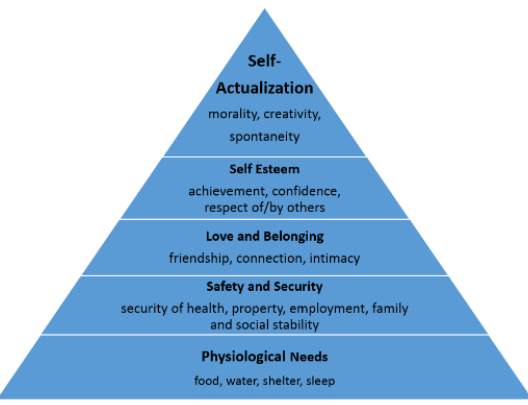
- Maslow’s Hierarchy – Theorizes that an individuals’ needs are organized in a five-tier hierarchy which imposes that each level of need must be satisfied fully or partially before the next level of needs can be determinately focused on. By examining the figure below, one can see that an individual who does not have their physiological needs met such as food, water, and shelter would not be able to focus on the next set of needs that is safety which include good health, structure, and security.
Figure 1
Maslow’s Hierarchy compared to Maslow Hierarchy for Teachers
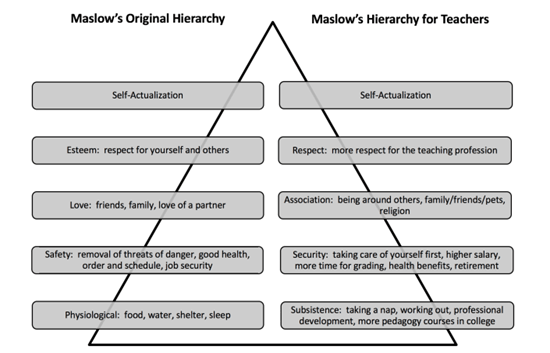
Note. Adapted from Fisher, M. H., & Crawford, B. (2020). “From School of Crisis to Distinguished”: Using Maslow’s Hierarchy in a Rural Underperforming School. Rural Educator, 41(1), 8–19. https://doi.org/10.35608/ruraled.v41i1.831
- Expectancy Theory – States that an individual’s motivation is high when they believe that if they put in a high degree of effort, there will be a higher degree of performance which then leads to a highly desired outcome (Vroom, 1964 as cited in Fisher & Crawford, 2020). This theory which is commonly related to organizational behavior identifies three factors which impact an individual’s motivation; expectancy, the anticipation that one has to achieve a goal; instrumentality, an individual’s perceptions as to what extent of performance will result in the outcome; and valance, how desirable are the probable outcomes available to the individual (2020).
- Equity Theory – An individual’s perception that their efforts or inputs will fairly result in expected and desirable outcomes in relation to the efforts of other individuals (Adams, 1963, as cited in Fisher & Crawford, 2020). In other words, this is the students or workers belief that for their efforts they will receive the same reward, benefit, or outcome as their coworker or peer who put in the same or like effort. Fairness of rewards.
- Vicarious Learning – This theory states thatin observational learning, an individual will be motivated to perform a task after watching another individual complete the task and seeing the positive outcome garnered. The learner will also be motivated to avoid certain tasks when seeing negative outcomes (Bandura, 1962, as cited in Fisher & Crawford, 2020).
Although this discussion is focused on Maslow’s Hierarchy it is important to recognize other motivational theories as they are also relevant and can be applied to the discipline of teaching and can also help an individual to understand what motivates them on a personal level.
Describe the link between Maslow’s hierarchy and direct or vicarious experiences you might have had in school
I grew up in a very rural area in northeastern Wisconsin. There were 9 people in my class at my elementary school, and 19 students in my graduating class when combined with the neighboring elementary school (which was 50 miles away) at my high school. We were very poor as my family owned a dairy farm, which during the era of the early 1980’s became more industrialized throughout the country and small farms in small farming communities were forced to sell and/or file bankruptcy. My dad was an alcoholic, and abusive toward my mom, brother, and I. My mom was also an alcoholic. After the farm was repossessed, my brother and I were left to take care of ourselves when our parents were unable to do so due to their alcoholism. We moved regularly after that, even out of our school district several times; there was a lot of poverty, chaos, and violence in our daily lives.
Although my brother and I did well at school in terms of meeting and exceeding academic expectations, we both had behavioral issues which hindered our ability to socialize, accept negative feedback, and follow rules. These behavioral issues which were directly related to the unstable behaviors of our parents as well as their lack of ability to properly provide a stable home environment led us to both have self-esteem issues, depression, anxiety, drug and alcohol problems, and later to my brother’s suicide. Adolescent depression is directly associated with academic problems and behavioral issues (Crandall et al., 2020). According to Berndt et al. (1982) depression hinders the growth that needs to take place in order to achieve self-actualization, as depression directly affects an adolescent or students’ ability to sleep and rejuvenate, control actions and behaviors, and oftentimes hinders a student’s ability to concentrate.
What might look like in today’s classrooms. How are Maslow’s hierarchy of needs, behavior, and student performance connected?
In today’s classrooms, this may look like the student who is falling asleep in class, is consistently angry, or disconnected from the environment. There could be consistent behavioral issues such as bullying, showing disrespect to classmates and instructors, and obvious signs of anxiety, depression, and sadness. When examining the lower levels of Maslow’s Hierarchy regarding safety needs, whether emotional, physical, or related to neighborhood safety, there are increased instances of adolescent depression when the safety need is not met. There is also a notable increase in depression when there are elements of social isolation and decreased perceptions of safety due to rural environments or neighborhoods that are not readily in proximity to other neighborhoods (Fisher & Crawford, 2020).
Love and belongingness also play important parts in a student’s ability to concentrate and interact in a positive manner with the learning environment. According to Carr and Springer (2010) families who have meals together, participate in regular activities together, where the parents actively participate in the child’s growth and development, and where parents actively monitor the children are generally associated with lower instances of adolescent depression. These findings relate to whether a child or adolescent will develop an internal or external locus of control. Locus of control, which falls within the esteem needs on the hierarchy is defined as the idea that individuals hold themselves accountable or place blame elsewhere as a result of certain outcomes (Rotter, 1966, as cited in Fisher & Crawford, 2020), is directly linked to adolescent depression. Adolescents who have an internal locus of control experience less depression than those with an external locus of control (Gorden et al., 2012).
A child raised in an unsafe and unpredictable environment is not likely to experience an internal locus of control as they have a hard time regulating themselves and concentrating due to the nature of the sporadic and chaotic environment. It is also important to mention that a parent’s locus of control does correlate to a child’s locus of control. A parent with an internal locus of control has a higher level of psychological well-being and that will be translated to the child (Lloyd & Hastings, 2009).
Students who come from homes and communities that are lacking in meeting the psychological needs of food water, shelter, and sleep, and also fail to meet the factors related to safety, security, and health are more likely to produce students who are prone to behavioral problems, emotional dysregulation, and mental health problems and illnesses. A student who is focused on survival, alleviating anxiety, combating depression, or fearful of going home to an unsafe parent or environment will not be able to fully concentrate, nor be fully engaged with the learning environment. Although there are instances of children from these types of environments excelling in academia, a higher percentage fall short of national averages and are deemed low performing (Fisher & Crawford, 2020). These students will have trouble, as my brother and I did, in making their way up the ladder to the higher levels of the hierarchy such as love, esteem, and self-actualization.
Although my childhood was not optimal, I do not wish for any other family, or any other set of experiences than the ones I had. No matter what happens to you as a child, you can wake up one day whether you are 18 or 80 and decide to cultivate a different life, and you can take all the difficulty you experienced and turn it into good for your children, your peers, your colleagues, and any other life you touch.
References
Berndt, D.J., Kaiser, C.F., & Van Aalst, F. (1982). Depression and Self-Actualization in gifted adolescents. Journal of Clinical Psychology, 38, 142-150.
Crandall, A., Powell, E. A., Bradford, G. C., Magnusson, B. M., Hanson, C. L., Barnes, M. D., Novilla, M. L. B., & Bean, R. A. (2020). Maslow’s Hierarchy of Needs as a Framework for Understanding Adolescent Depressive Symptoms Over Time. Journal of Child & Family Studies, 29(2), 273–281. https://doi.org/10.1007/s10826-019-01577-4
Fisher, M. H., & Crawford, B. (2020). “From School of Crisis to Distinguished”: Using Maslow’s Hierarchy in a Rural Underperforming School. Rural Educator, 41(1), 8–19. https://doi.org/10.35608/ruraled.v41i1.831
Gordon, M. S., Tonge, B., & Melvin, G. A. (2012). The self-efficacy questionnaire for depressed adolescents: a measure to predict the course of depression in depressed youth. Australian & New Zealand Journal of Psychiatry, 46, 47–54
Jones, G., & George, J. (2017). Essentials of Contemporary Management (7th ed.). New York, NY: McGraw-Hill Education.
Kovach, M. (2018). A Review of Classical Motivation Theories: Understanding the Value of Locus of Control in Higher Education. Journal of Interdisciplinary Studies in Education, 7(1), 34–53. https://doi.org/10.32674/jise.v7i1.1059
Lloyd, T., & Hastings, R. (2009). Parental locus of control and psychological well-being in mothers of children with intellectual disability. Journal of Intellectual & Developmental Disability, 34(2), 104-115
Locke, E., & Latham, G. (2002). Building a practically useful theory of goal setting and task motivation. American Psychologist 57(9), 705-717
Robbins, S. & Judge, T. (2017). Organizational Behavior (17th ed.). Boston, MA: Pearson.



 i do what waunt
Leave a comment